Table of Contents
- Step 1: Know What 'Hot' and 'Cold' Really Mean
- Step 2: Pick a Fixed Window and Stick to It
- Step 3: Sort the Hot List by Frequency, Not by Feeling
- Step 4: Use the Cold List as a Contrarian Filter
- Step 5: Check the Gap Between Appearances
- Step 6: Build Your Ticket Like a Portfolio, Not a Hunch
- Step 7: Track, Review, and Adjust—But Never Expect a Pattern
Step 1: Know What 'Hot' and 'Cold' Really Mean
If you've been buying PCSO lotto tickets for a while, you've probably heard someone at the lotto outlet say, "Init 'yan ngayon, sunod-sunod ang labas." That's the hot number talk. The opposite—numbers that haven't shown up in a long stretch—are what we call cold. Simple enough, right? But the terms get tossed around loosely, so let's define them properly before we build a routine around them.
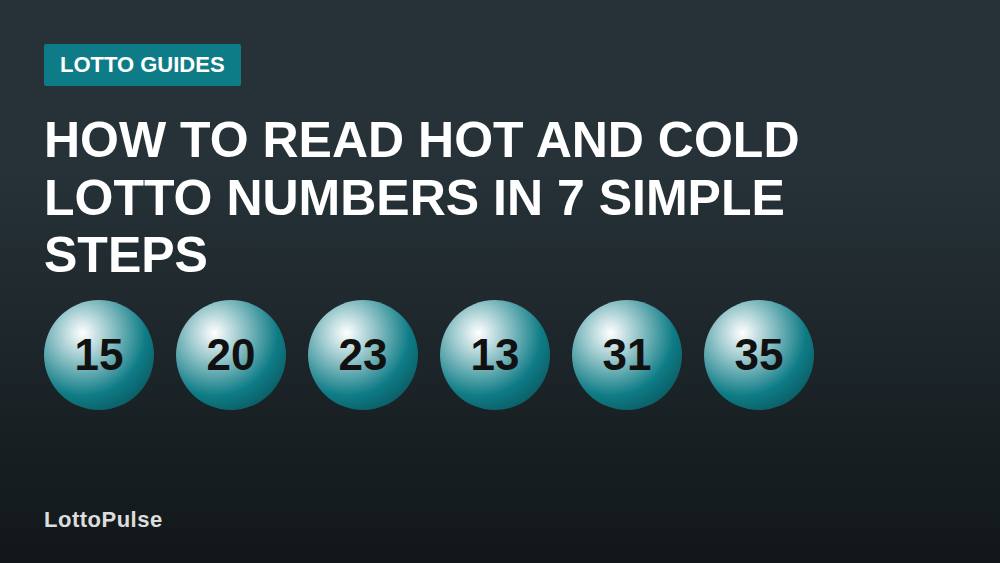
A hot number is one that has appeared more frequently than average within a specific window of draws. In our recent 28-draw sample, the hottest numbers are 15, 20, and 23, each hitting 3 times. That might not sound like much, but in a 6/42 or 6/45 game, seeing a number three times in 28 draws is above the expected rate.
Cold numbers are at the other end. In the same 28 draws, numbers like 06, 04, 03, 55, 48, 44, 43, 40, 32, and 29 appeared only once. They're not "due"—that's a common misconception—but they are statistically quieter than the rest.
Here's the key point: hot and cold labels are descriptive, not predictive. They tell you what happened in the past 28 draws. They do not tell you what will happen in the next draw. Keep that in mind as we go through the steps.
| Hot number | Times | Cold number | Times |
|---|---|---|---|
| 15 | 3 | 06 | 1 |
| 20 | 3 | 04 | 1 |
| 23 | 3 | 03 | 1 |
| 13 | 2 | 55 | 1 |
| 31 | 2 | 48 | 1 |
| 35 | 2 | 44 | 1 |
| 38 | 2 | 43 | 1 |
| 39 | 2 | 40 | 1 |
| 41 | 2 | 32 | 1 |
| 42 | 2 | 29 | 1 |
Step 2: Pick a Fixed Window and Stick to It
The biggest mistake casual bettors make is changing the window whenever it suits them. One week they look at 10 draws, the next week 50. That's how you end up with confusing, conflicting signals.
For this routine, we're using 28 draws as our fixed window. Why 28? It's roughly a month of PCSO draws for most major games, which gives enough data to see patterns without dragging in ancient history. It's also easy to update—once a week, just add the latest results and drop the oldest ones.
Pick a window that matches how often you play:
- Casual player (once a week): 20–30 draws is fine.
- Regular player (3–4 times a week): 30–50 draws.
- Daily player: 50–100 draws, but be ready for more noise.
The table below shows the hot and cold numbers from our 28-draw sample. Notice how the hot list clusters around the low-to-mid range (13–42) while the cold list includes a few high numbers like 55 and 48. That's normal variance, not a secret code.
Step 3: Sort the Hot List by Frequency, Not by Feeling
Once you have your window, list every number that appeared more than once. Then sort them by how many times they hit. In our sample, the top tier is clear:
- 15, 20, 23 — 3 appearances each
- 13, 31, 35, 38, 39, 41, 42 — 2 appearances each
That's 10 numbers total. If you're building a 6-number combination, you could pick 3–4 from this hot list and fill the rest from elsewhere. But don't just copy the top 6. That's a recipe for a popular combination—and if you win, you'll share the pot with a dozen other bettors who did the same thing.
A smarter approach: take two or three from the hot list, then mix in numbers from the mid-frequency range (those that appeared once or twice outside the top tier). This keeps your ticket from looking like everyone else's.
Hot numbers are a conversation starter, not a guarantee. The draw machine doesn't remember last week.
Step 4: Use the Cold List as a Contrarian Filter
Cold numbers scare some bettors. "Bakit 'yan pa ang pipiliin ko, eh ang tagal nang hindi lumalabas?" Fair question. But here's the thing: in a random draw, every number has the same probability every single time. A number being cold doesn't make it more likely to appear next—nor less likely.
So why bother with the cold list at all? Because it can help you avoid overloading on hot numbers. If everyone is chasing 15, 20, and 23, the payout for those combinations (if they win) could be diluted. By including one or two cold numbers—like 06, 04, or 03—you differentiate your ticket.
Here's a practical filter:
- Pick 2–3 hot numbers from the top tier.
- Pick 1–2 numbers from the mid-frequency range (appeared 2 times but not in the top 3).
- Pick 1 cold number from the list of those that appeared only once.
- Add 1 wildcard—a number you just feel good about, regardless of stats.
That gives you a balanced 6-number line that isn't purely hot-chasing or purely contrarian.
Step 5: Check the Gap Between Appearances
Frequency alone doesn't tell the whole story. You also want to know when a number last appeared. A number that hit 3 times but hasn't shown up in the last 10 draws is different from one that hit 3 times in the last 5 draws.
For the hot numbers in our sample, check the gap:
- 15 — 3 hits, last seen recently
- 20 — 3 hits, last seen a few draws ago
- 23 — 3 hits, last seen within the last 7 draws
If a hot number has been quiet for 8–10 draws, some bettors call it a "cooling" number. It's not a signal to avoid it—remember, random—but it might mean the hot streak is just normal variance evening out. Use this as a tiebreaker when you have two numbers and can't decide.
For cold numbers, a long gap (15+ draws without a hit) is common. In a 6/42 game, the odds of any specific number appearing in a single draw are about 1 in 7. So going 15 draws without a hit isn't unusual at all. Don't let the gap fool you into thinking a number is "overdue."
Step 6: Build Your Ticket Like a Portfolio, Not a Hunch
Think of your 6-number combination like a small portfolio. You want a mix of assets—some hot, some cold, some in between. Here's a template you can reuse every week:
- 2 numbers from the hot list (top 3 frequency)
- 2 numbers from the mid-frequency list (appeared 2 times, not top 3)
- 1 number from the cold list (appeared once)
- 1 personal pick (birthday, anniversary, lucky number)
This gives you a structured ticket without being rigid. You can also rotate the hot and cold picks every few draws to keep things fresh. The goal isn't to crack a code—it's to make your picks deliberate instead of random impulse buys.
One more thing: don't spend more than your usual budget just because you have a "system." A system doesn't change the odds. It just makes the experience more engaging. Set a weekly limit and stick to it.
Step 7: Track, Review, and Adjust—But Never Expect a Pattern
The final step is the easiest to skip and the most important for long-term discipline: keep a simple log. After each draw, jot down the 6 winning numbers. Every 28 draws, recalculate your hot and cold lists. You'll notice that the lists change over time. Numbers that were hot three months ago might be cold now, and vice versa.
That's the nature of randomness. There is no permanent hot number. The moment you think you've found a sure thing, the pattern shifts. This isn't a flaw in the system—it's the system working as designed.
Use the table above as your starting point. Update it weekly. Treat the hot and cold labels as conversation pieces, not commandments. And always remember: PCSO lotto draws are random. Every combination has the same chance. Play for fun, play within your means, and never bet money you can't afford to lose.
If you enjoy tracking numbers, that's great—it adds a layer of engagement to the game. But if you ever feel like you're due for a win, step back. The lottery doesn't owe anyone anything. The house edge is real, and the only guaranteed winner is the one who stops before it becomes a problem.